






Les produits en caoutchouc vulcanisé et les produits en caoutchouc mousse vulcanisé sont-ils issus du même procédé ?
Release time: 2026-10-27
— The “Foaming–Vulcanization Match” and the “Solid Sealing” Route: Two Parallel Rubber Manufacturing Pathways
In routine technical exchange and procurement communication across the rubber industry, “vulcanized rubber products” and “vulcanized sponge rubber products” are often discussed under the shared label of “vulcanization,” sometimes treated as though they were merely two product forms of a single process. From the standpoint of process logic, structural objective, and service behavior, however, they belong to two parallel technological routes—not two variants of the same process. This distinction carries direct implications for the selection, manufacturing control, and regulatory classification of rubber seals.
A Shared Starting Point, a Fork in the Road
The two do share the same chemical foundation: vulcanization, the crosslinking of linear rubber molecules into a three-dimensional network that imparts elasticity and resilience. Neither solid vulcanized rubber products nor vulcanized sponge rubber products can achieve stable mechanical properties without it.
The divergence begins after vulcanization is initiated. The manufacture of vulcanized sponge rubber is, in essence, a dual-kinetics process of “vulcanization + foaming.” A blowing agent incorporated into the compound decomposes upon heating to generate gas while the rubber matrix simultaneously crosslinks. The two rates must be precisely matched: if vulcanization proceeds too quickly, the network sets before the gas can fully expand the matrix, resulting in insufficient foaming and elevated density; if foaming outpaces vulcanization, gas escapes while the matrix still lacks sufficient strength, leading to cell coalescence and structural collapse. Industry studies consistently confirm that only when the vulcanization rate and foaming rate fall within a matched window can a sponge structure with high closed-cell content, fine and uniformly distributed cells, and low apparent density and compression set be obtained. The core process challenge of vulcanized sponge rubber, therefore, is not simply “vulcanizing rubber into shape,” but creating and preserving a porous structure within a vulcanized network. Representative products include: sponge rubber sealing strips, EPDM foamed sealing strips, sponge rubber gaskets, foamed rubber sheets/sponge rubber sheets, closed-cell sponge rubber tubes, sponge rubber vibration-damping pads, microcellular rubber sealing gaskets, sponge rubber rollers, sponge rubber plugs, and acoustic sponge rubber parts.
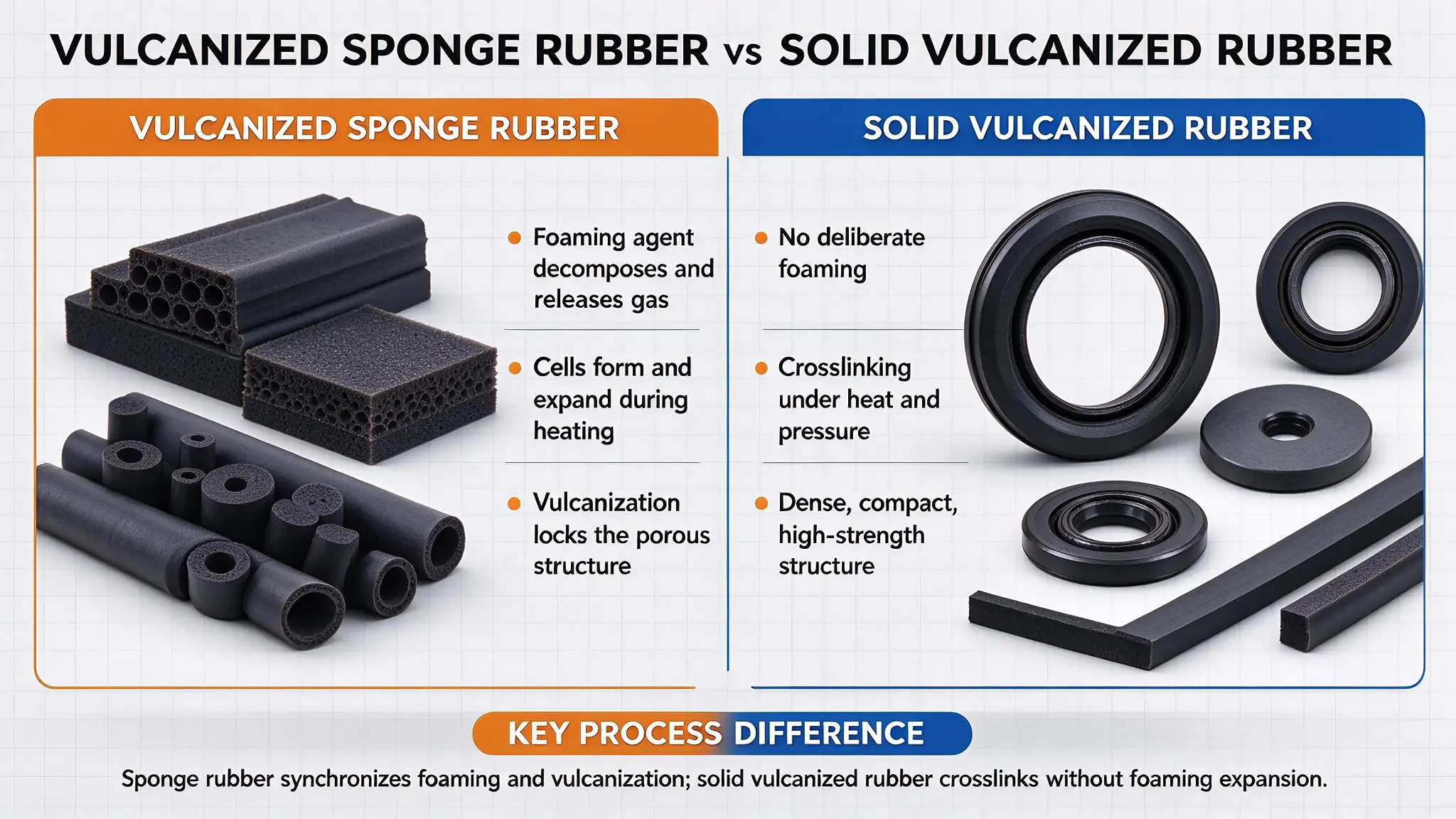
Vulcanized rubber products—most notably typical rubber seals—follow a different route. For O-rings, gaskets, and solid sealing profiles, the functional basis is controlled compression of a dense elastomer. Under assembly, a seal undergoes an initial compressive deformation (typically on the order of 8–25%); this generates an initial contact stress at the sealing interface, and leakage is prevented when that contact stress exceeds the internal pressure of the sealed medium. This mechanism demands a continuous, void-free, non-porous material matrix. Any cell or interconnected porosity constitutes a potential leak path or stress concentration site and directly undermines sealing reliability. The process focus for vulcanized rubber seals therefore falls on compound cleanliness, mold-forming densification, and uniformity of cure, rather than on the introduction or control of any gas phase. Representative products include: O-rings, solid rubber flat gaskets, rubber oil seals, solid rubber sealing rings, V-rings/U-rings, rubber sealing gaskets, solid rubber sealing strips, rubber diaphragms, rubber vibration mounts/rubber springs, solid rubber plugs, and solid rubber rollers.
Classification and Standards: Institutional Confirmation of the Divide
This process divide is not merely a matter of technical description; it is institutionally confirmed in customs classification and product standards.
Within the HS system, vulcanized sponge rubber articles fall under heading 4016.10 (“Of cellular rubber”) , alors que solid vulcanized rubber seals fall under 4016.93 (“Gaskets, washers and other seals”) . U.S. customs rulings state the matter plainly: a gasket made of cellular rubber, even where it functions as a seal, is provided for under 4016.10 as an other article of cellular rubber rather than under 4016.93 as an other article of vulcanized rubber—gaskets, washers and other seals; the seals of 4016.93 correspond to non-cellular, non-sponge solid vulcanized rubber. The classification logic thus asks first whether the material contains numerous cells dispersed throughout its mass, not whether the product name contains the word “seal.”
At the level of technical standards, the key performance parameters for rubber seals point in the same direction. In material specifications for pipe-joint sealing rings, requirements for elongation at break, ensemble de compression, and stress relaxation apply specifically where rubber directly participates in sealing or where long-term sealing stability is required. These parameters measure the ability of a dense elastomer to retain rebound stress under prolonged compression—a reference material state that is solid rubber. Sponge rubber can provide compressive cushioning in static gaps, but its compression behavior is governed by cell-wall buckling and collapse, a physical process distinct from the contact-stress retention mechanism of a solid seal. The two cannot be treated as equivalent under a single set of sealing-performance criteria.
Practical Consequences for Manufacturing and Selection
Treating the two as the same process is misleading at both the manufacturing and the selection stage. In manufacturing, the process window for vulcanized sponge rubber is considerably narrower than that for solid articles: the decomposition profile of the blowing agent, the plateau region of the curing curve, and the design of mold venting and expansion space are independent variables absent from solid seal production. In selection, substituting a sponge rubber article for a solid rubber seal in applications requiring long-term contact-stress retention—dynamic or high-pressure sealing, for example—may appear to “compress and close” initially, but its long-term compression set and stress relaxation behavior differ fundamentally from those of a solid seal. Conversely, using a solid seal to fill irregular, large-gap, or vibration-damping locations may generate excessive assembly stress or poor interfacial conformity because of insufficient compressibility.
The global gaskets and seals market continues to expand at a steady pace, and rubber seals, as a foundational category within it, bear directly on the operational reliability of automotive, industrial equipment, and building-services systems. Against that backdrop, clarifying the process fork beneath the shared heading of “vulcanization” is not terminological over-differentiation; it is a necessary technical link connecting material selection, process control, and final sealing function. Vulcanized rubber products and vulcanized sponge rubber products are not the same process; they share vulcanization, but after vulcanization they move toward different structural objectives and engineering purposes. For rubber seals, that distinction is especially not to be blurred.
When making the judgment, consider three points: whether the formulation contains a blowing agent, whether a cellular structure is present, and the density and compression behavior. Product names containing “sponge,” “foamed,” “microcellular,” or “closed-cell” generally belong to the vulcanized sponge rubber process; product names containing “solid” or “dense,” or O-rings, oil seals, flange gaskets, etc. that are not designated as foamed, generally belong to the solid vulcanized rubber process.