






-
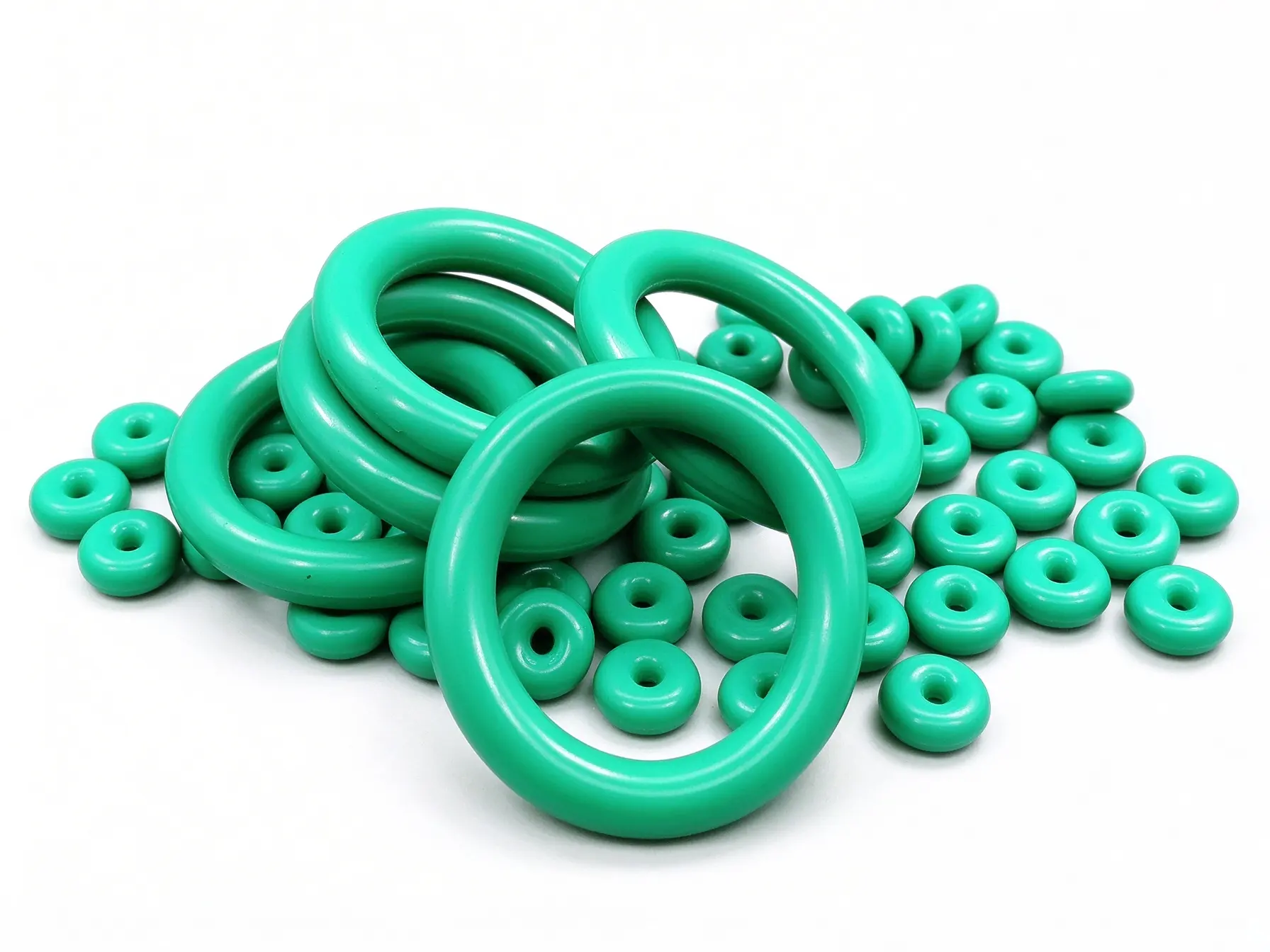
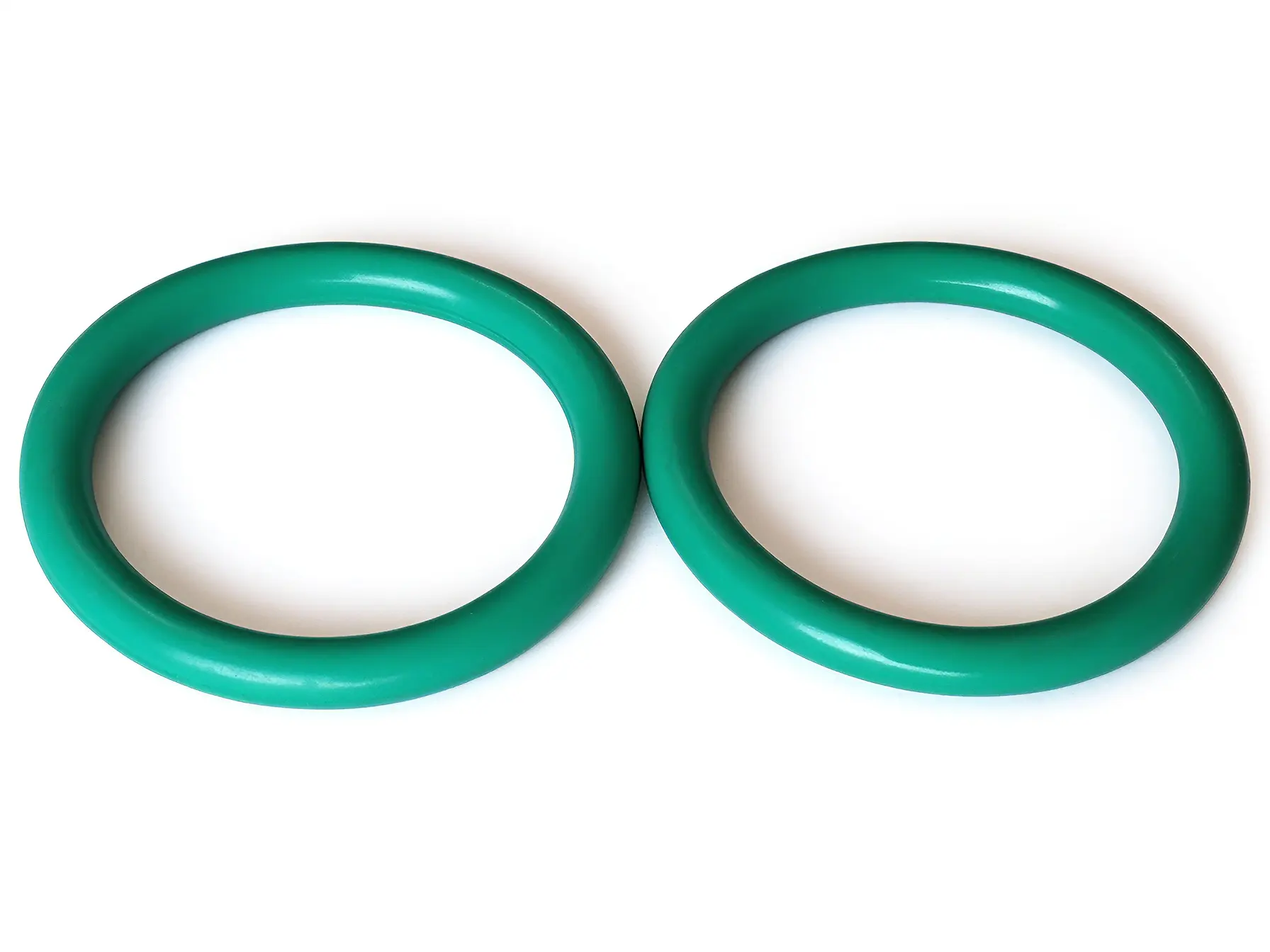
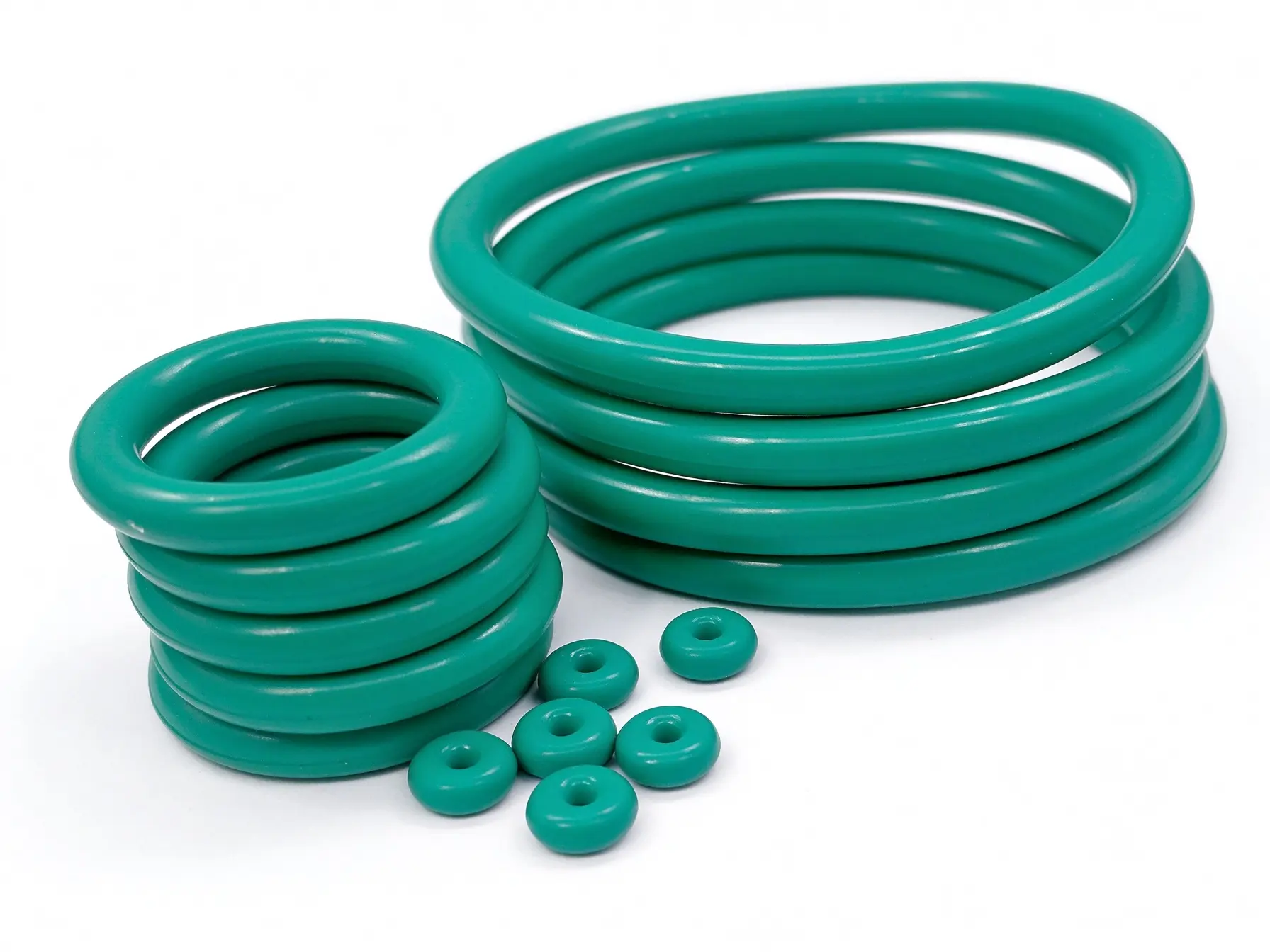
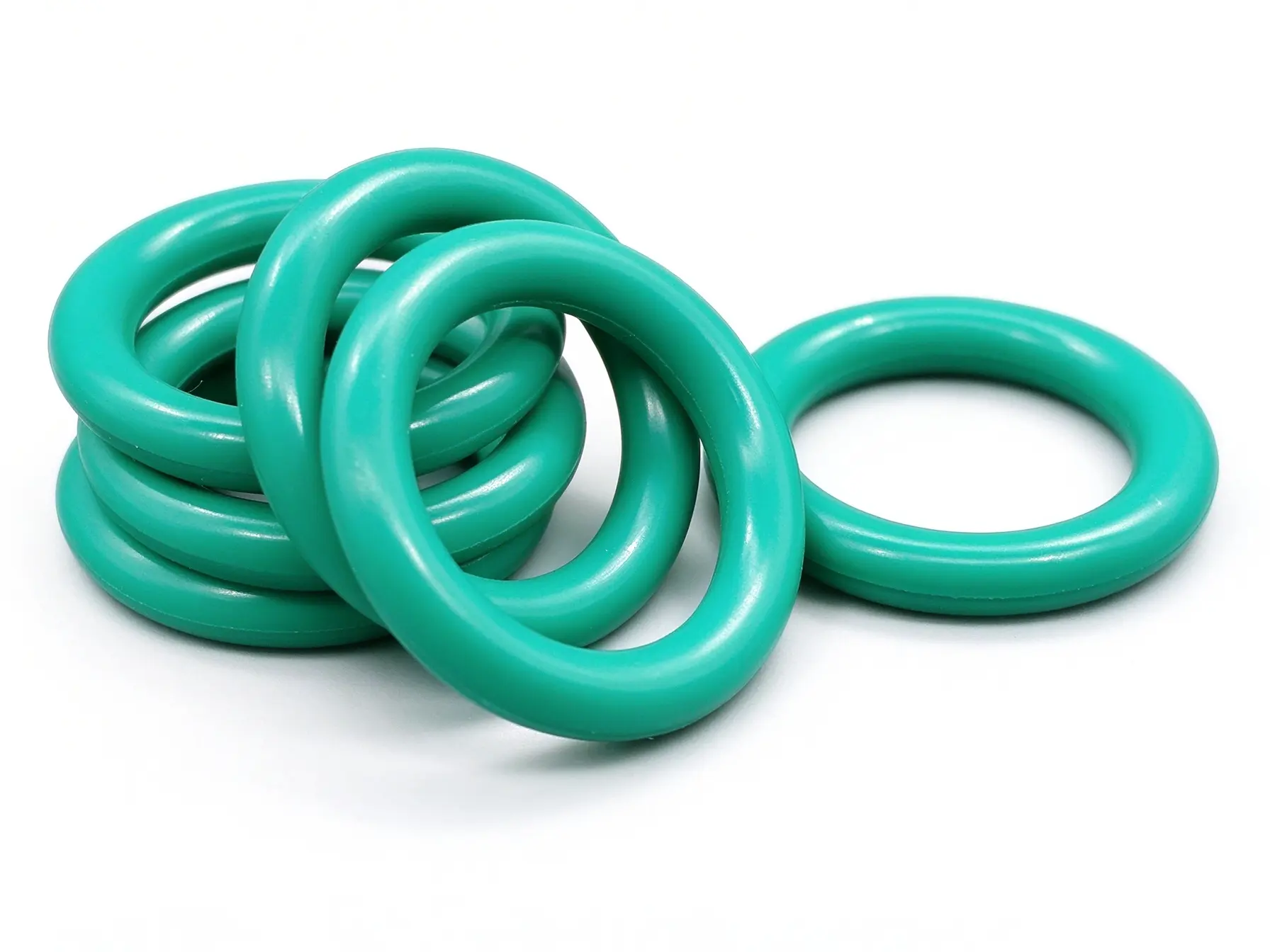
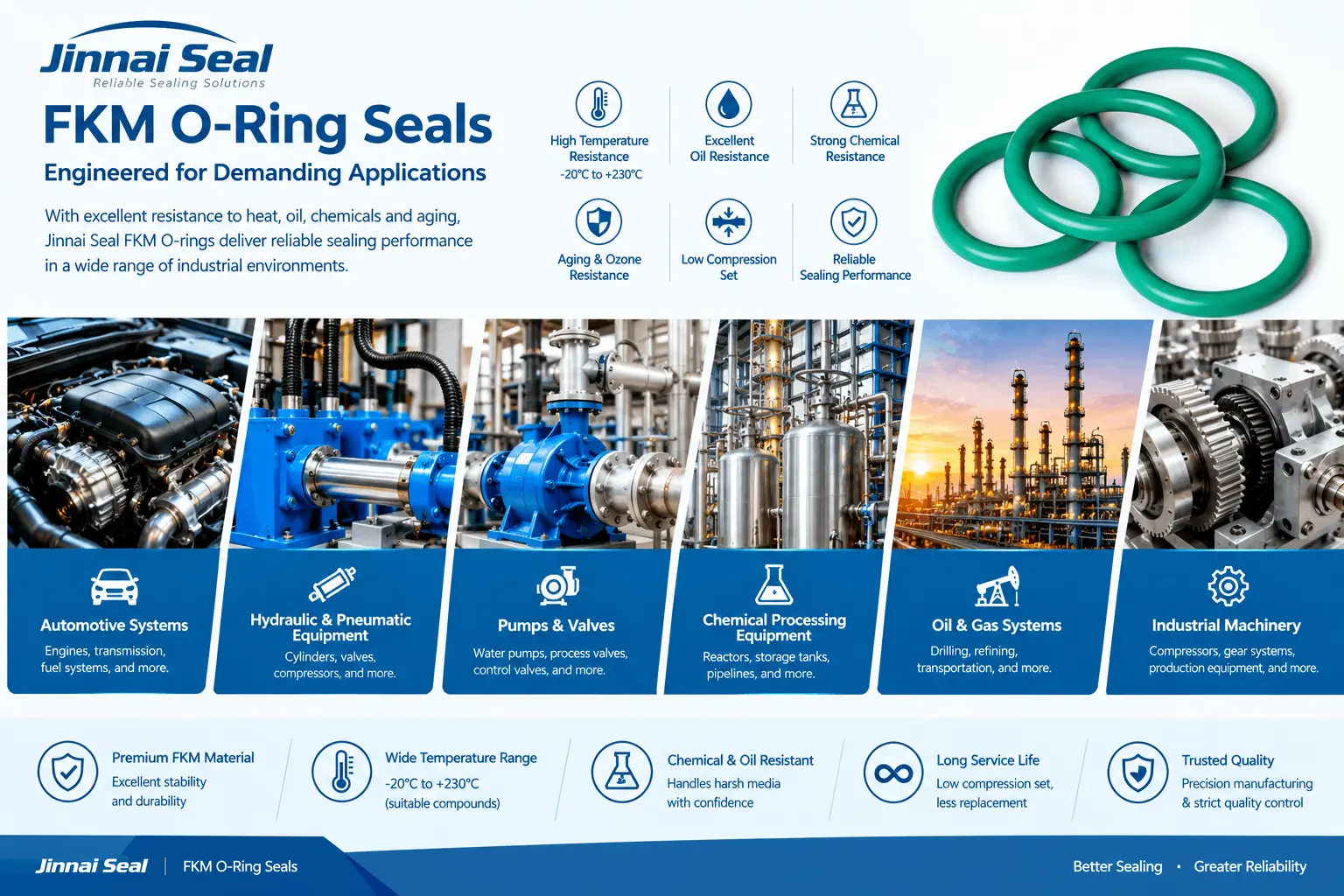
Made from high quality FKM rubber, these O rings offer excellent heat resistance for sealing applications in various industrial equipment.
-
Designed for excellent oil and chemical resistance, these O rings are suitable for lubricants, fuels, and various industrial environments.
-
With good elasticity and reliable sealing performance, these O rings are widely used in pumps, valves, pipelines, and machinery. Food contact applications require verification of relevant material certifications.
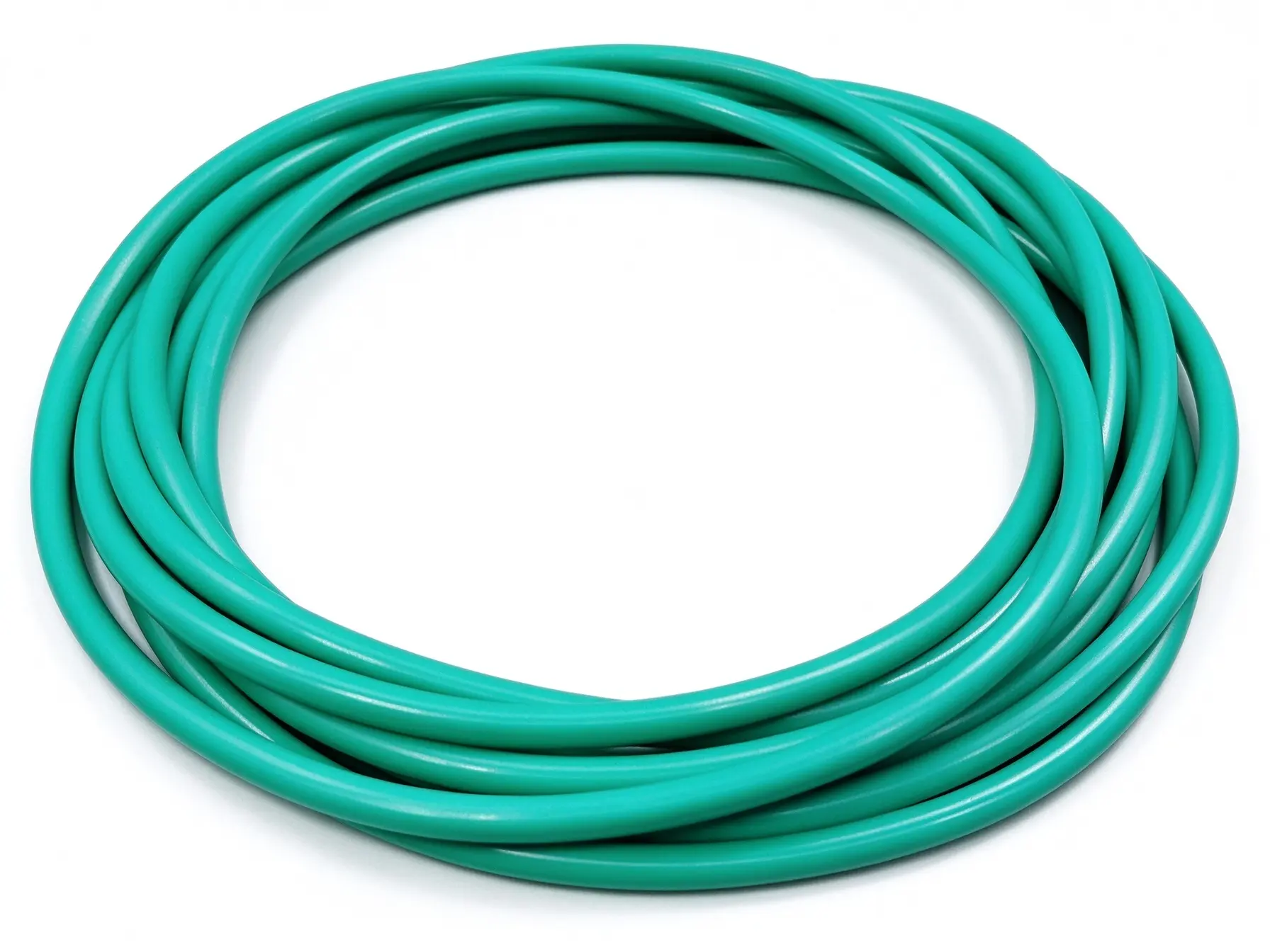
FKM O‑Rings
High Temperature Oil and Chemical-Resistant FKM O-Rings for Industrial Sealing
- Description
- Download
-
Our FKM O Rings (Fluorocarbon Rubber O-Rings) are high-performance industrial rubber seals designed for demanding sealing applications. Made from high-quality FKM rubber, these high temperature O rings offer excellent resistance to heat, oils, fuels, and many chemicals. With reliable sealing performance, good compression set resistance, and long service life, FKM rubber O-rings are ideal for harsh operating environments.
As a professional FKM O-ring manufacturer and supplier, we provide custom FKM O-rings, fluorocarbon rubber seals, oil-resistant O-rings, chemical-resistant O-rings, and industrial rubber sealing products in various sizes, cross-sections, hardness levels, and colors. Our custom rubber seals are suitable for automotive systems, hydraulic cylinders, pneumatic equipment, pumps, valves, oil and gas equipment, chemical processing machinery, and other industrial sealing applications. We support OEM and ODM customization to meet specific sealing requirements, operating temperatures, and media compatibility needs.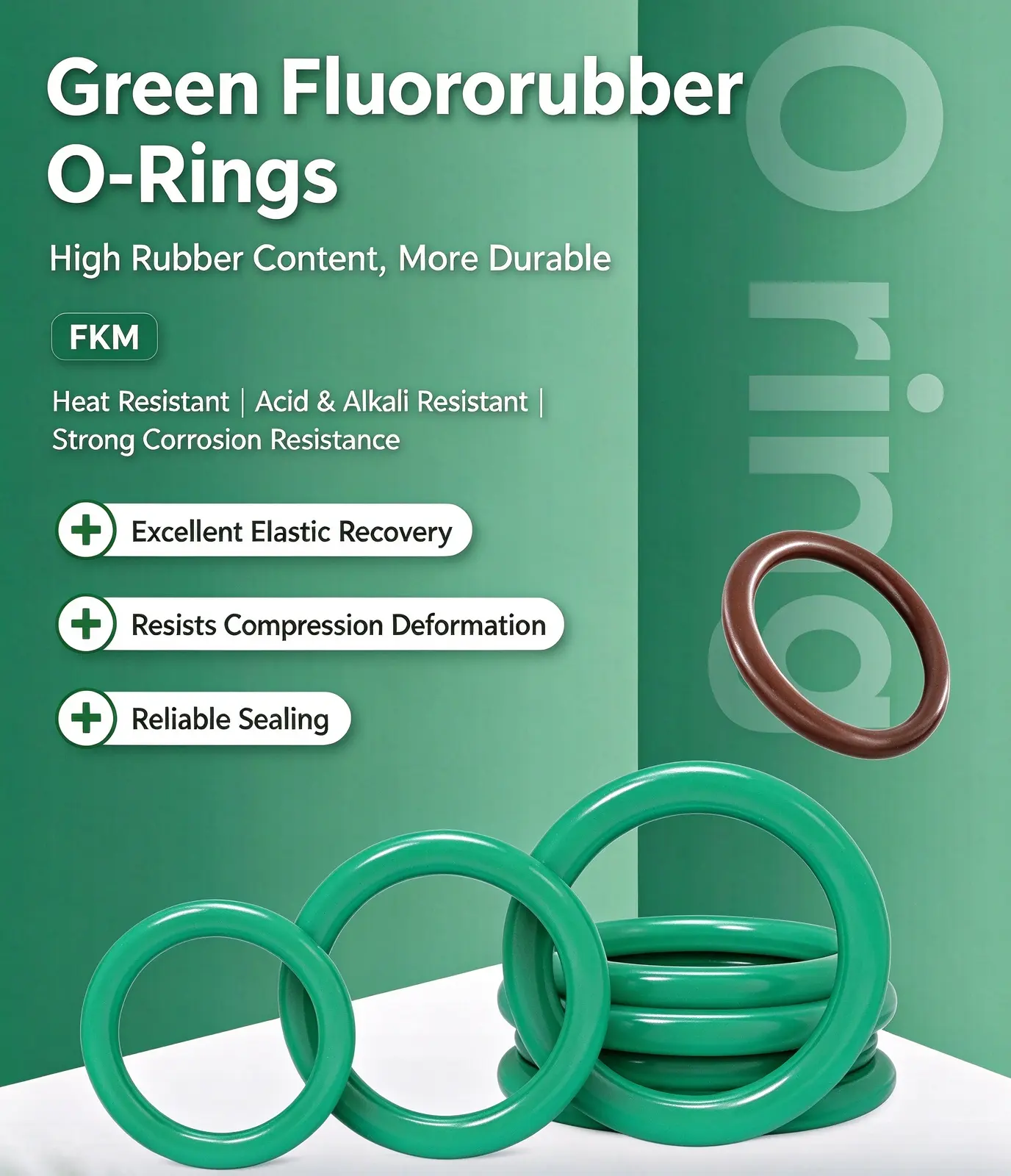
FKM O- Ring Technical Table
Specification Details Product Name FKM O Ring Seal Material Fluoroelastomer FKM Hardness 70 Shore A, customizable Operating Temperature Approx. -20°C to +200°C Oil Resistance Excellent Chemical Resistance Depends on chemical medium Weather Resistance Good Ozone Resistance Good Tensile Strength Depends on compound formulation Size Standards AS568, ISO 3601, custom sizes Color Typically black, customizable Cross Section Circular Applications Pumps, valves, hydraulic systems, automotive and industrial machinery Food Contact Compliance Subject to material certification Customization Size, hardness, and compound formulation Correct measure the O-Rings Size
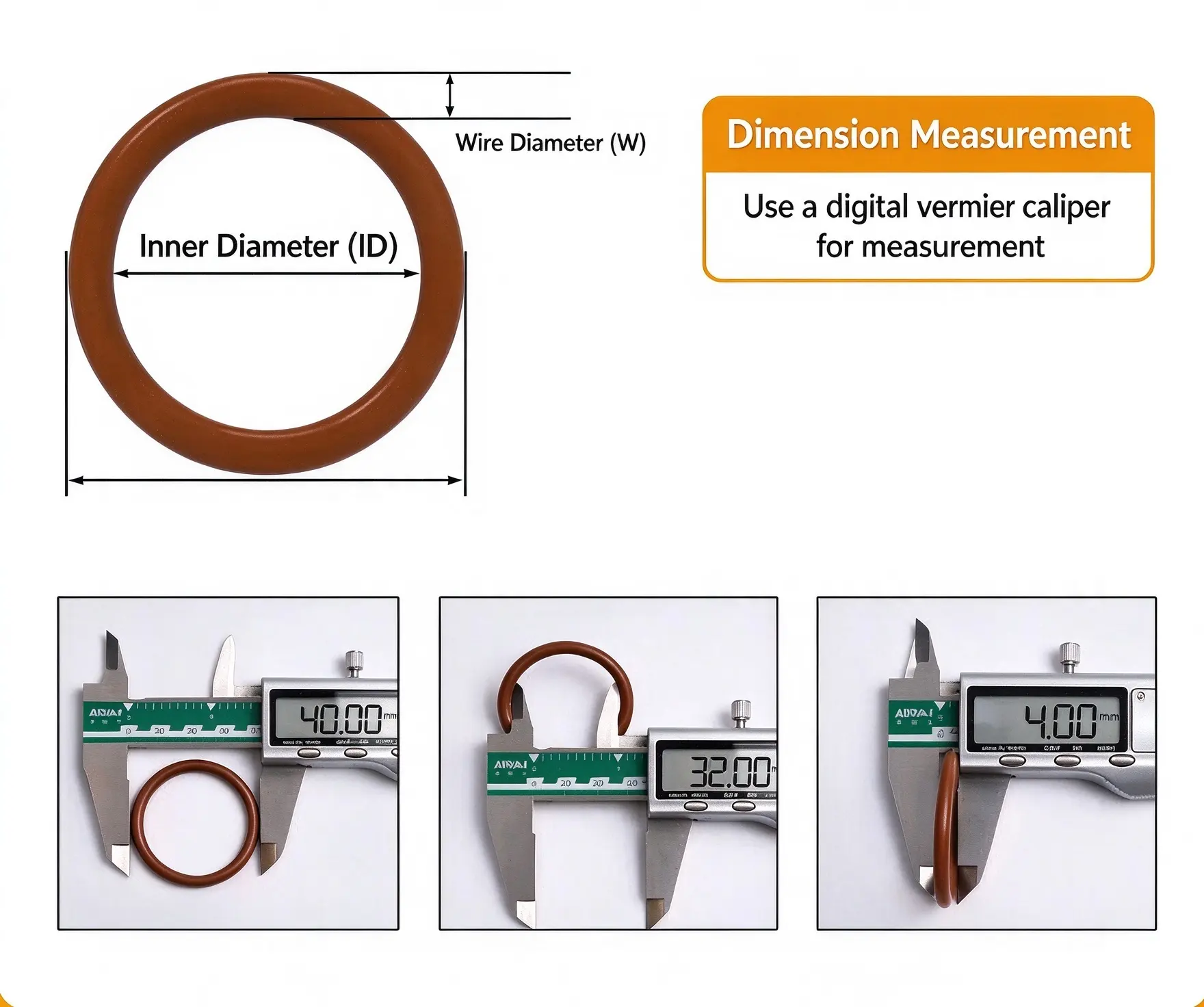
1.Do not measure O-rings with a ruler.
2.Use a caliper to accurately get ID, OD and cross-section CS.
3. Rubber O-rings deform easily. Accurate measurement ensures proper fit and prevents leakage.
O-Ring ID size tolerance for AS568 standard
Cross-Section Tolerance (CS Tolerance)
In AS568, cross-section tolerance is fixed by series and does not vary with inside diameter. Each dash-number series corresponds to a nominal cross-section.
Series (Dash Range) Nominal CS (inch) Nominal CS (mm) CS Tolerance (inch) CS Tolerance (mm) 000 Series (-001 to -099) 0.070" 1.78 mm ±0.003" ±0.08 mm 100 Series (-100 to -199) 0.103" 2.62 mm ±0.003" ±0.08 mm 200 Series (-200 to -299) 0.139" 3.53 mm ±0.004" ±0.10 mm 300 Series (-300 to -399) 0.210" 5.33 mm ±0.005" ±0.13 mm 400 Series (-400 to -499) 0.275" 6.99 mm ±0.006" ±0.15 mm Inside Diameter Tolerance (ID Tolerance)
Unlike cross-section tolerance, ID tolerance widens in steps as the inside diameter increases.
ID Range (inch) ID Tolerance (inch) ID Range (mm) ID Tolerance (mm) 0.000 – 0.070 ±0.005" 0.00 – 1.79 ±0.12 mm 0.071 – 0.110 ±0.005" 1.80 – 2.80 ±0.13 mm 0.111 – 0.157 ±0.006" 2.81 – 4.00 ±0.14 mm 0.158 – 0.208 ±0.006" 4.01 – 5.30 ±0.15 mm 0.209 – 0.279 ±0.006" 5.31 – 7.10 ±0.16 mm 0.280 – 0.334 ±0.007" 7.11 – 8.50 ±0.17 mm 0.335 – 0.383 ±0.007" 8.51 – 9.75 ±0.18 mm 0.384 – 0.464 ±0.007" 9.76 – 11.80 ±0.19 mm 0.465 – 0.519 ±0.008" 11.81 – 13.20 ±0.21 mm 0.520 – 0.590 ±0.009" 13.21 – 15.00 ±0.22 mm 0.591 – 0.629 ±0.009" 15.01 – 16.00 ±0.23 mm 0.630 – 0.669 ±0.009" 16.01 – 17.00 ±0.24 mm 0.670 – 0.747 ±0.010" 17.01 – 19.00 ±0.25 mm 0.748 – 0.810 ±0.010" 19.01 – 20.60 ±0.26 mm 0.811 – 0.834 ±0.011" 20.61 – 21.20 ±0.27 mm 0.835 – 0.881 ±0.011" 21.21 – 22.40 ±0.28 mm 0.882 – 0.929 ±0.011" 22.41 – 23.60 ±0.29 mm 0.930 – 0.984 ±0.012" 23.61 – 25.00 ±0.30 mm 0.985 – 1.043 ±0.012" 25.01 – 26.50 ±0.31 mm 1.044 – 1.102 ±0.013" 26.51 – 28.00 ±0.32 mm 1.103 – 1.141 ±0.013" 28.01 – 29.00 ±0.33 mm 1.142 – 1.180 ±0.013" 29.01 – 30.00 ±0.34 mm 1.181 – 1.240 ±0.014" 30.01 – 31.50 ±0.35 mm 1.241 – 1.318 ±0.014" 31.51 – 33.50 ±0.36 mm 1.319 – 1.358 ±0.015" 33.51 – 34.50 ±0.37 mm 1.359 – 1.436 ±0.015" 34.51 – 36.50 ±0.38 mm 1.437 – 1.476 ±0.015" 36.51 – 37.50 ±0.39 mm 1.477 – 1.574 ±0.016" 37.51 – 38.70 ±0.40 mm 1.575 – 1.621 ±0.017" 41.21 – 42.50 ±0.43 mm 1.622 – 1.673 ±0.017" 42.51 – 45.00 ±0.44 mm 1.674 – 1.771 ±0.017" 45.01 – 46.20 ±0.45 mm 1.772 – 1.818 ±0.018" 46.21 – 47.50 ±0.46 mm 1.819 – 1.869 ±0.018" 47.51 – 48.70 ±0.47 mm 1.870 – 1.917 ±0.019" 48.71 – 50.00 ±0.48 mm Quick Inch–Metric Conversion Reference
Inch Tolerance Metric Equivalent (approx.) ±0.003" ±0.08 mm ±0.004" ±0.10 mm ±0.005" ±0.13 mm ±0.006" ±0.15 mm ±0.007" ±0.18 mm ±0.008" ±0.20 mm ±0.009" ±0.23 mm ±0.010" ±0.25 mm ±0.012" ±0.30 mm ±0.015" ±0.38 mm ±0.018" ±0.46 mm ±0.020" ±0.51 mm Remark:AS568 tolerance control rests on two independent variables: cross-section tolerance is fixed by series, while ID tolerance widens with size. For any specific O-ring, the controlling tolerance values come from the dash-number dimensional table—not from a single universal tolerance figure.
Our FKM O-Rings Products Advantages
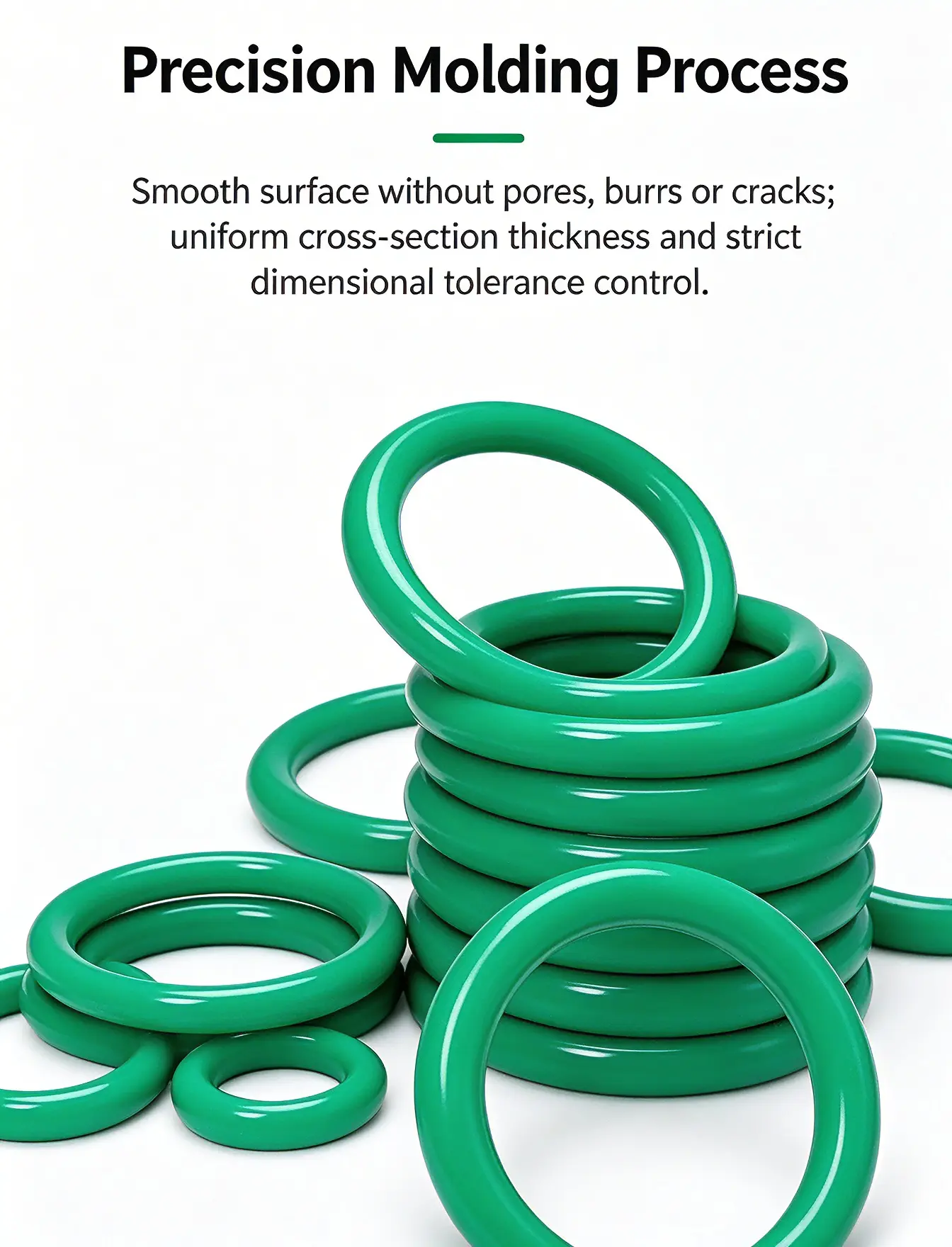
Manufactured with attention to surface finish, dimensional accuracy, and cross-sectional consistency. Products are inspected for surface defects such as pores, burrs, and cracks according to applicable quality requirements.
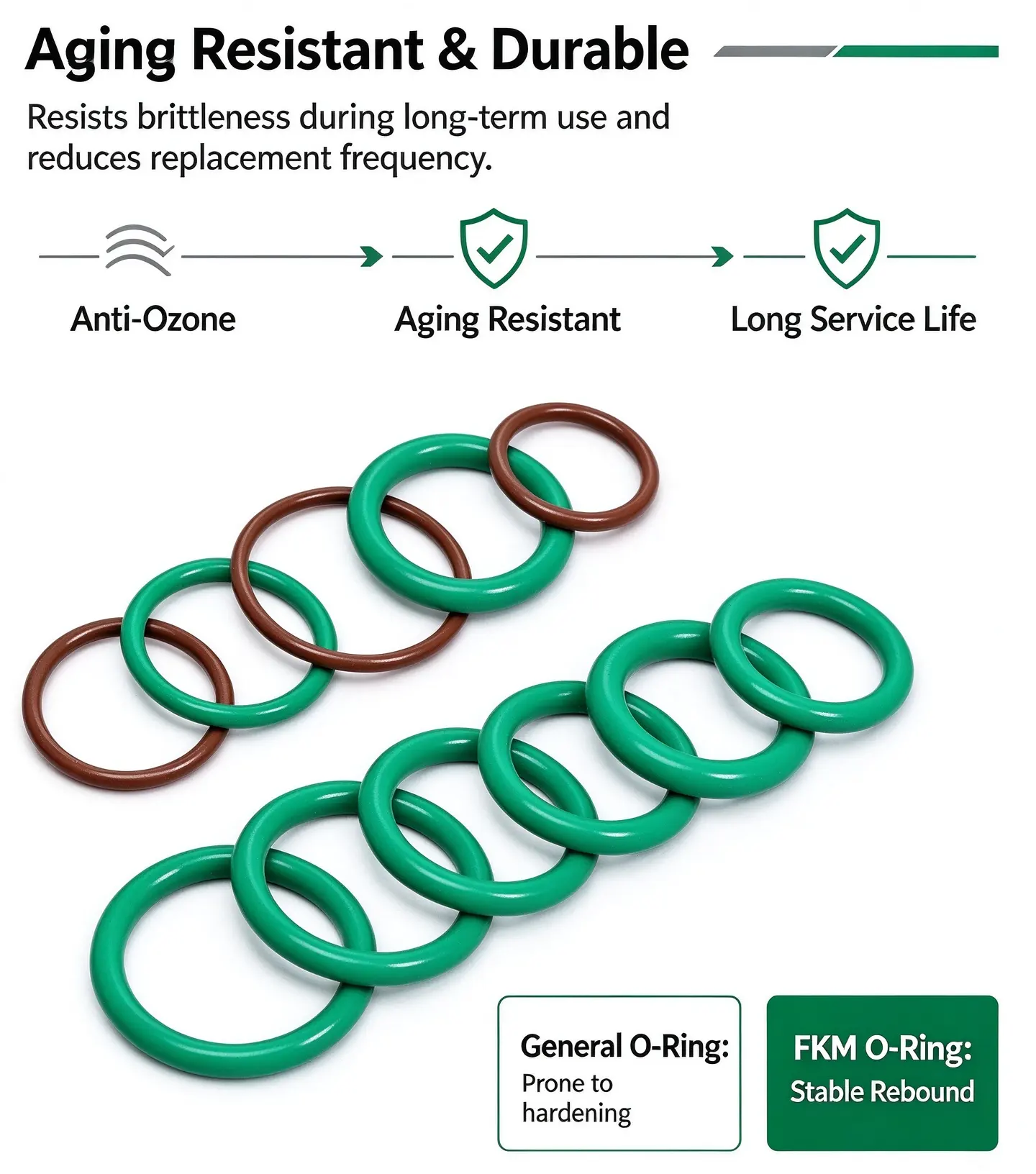
Designed to resist ozone and aging, FKM O rings maintain reliable sealing performance over extended periods under suitable operating conditions, helping reduce replacement frequency.
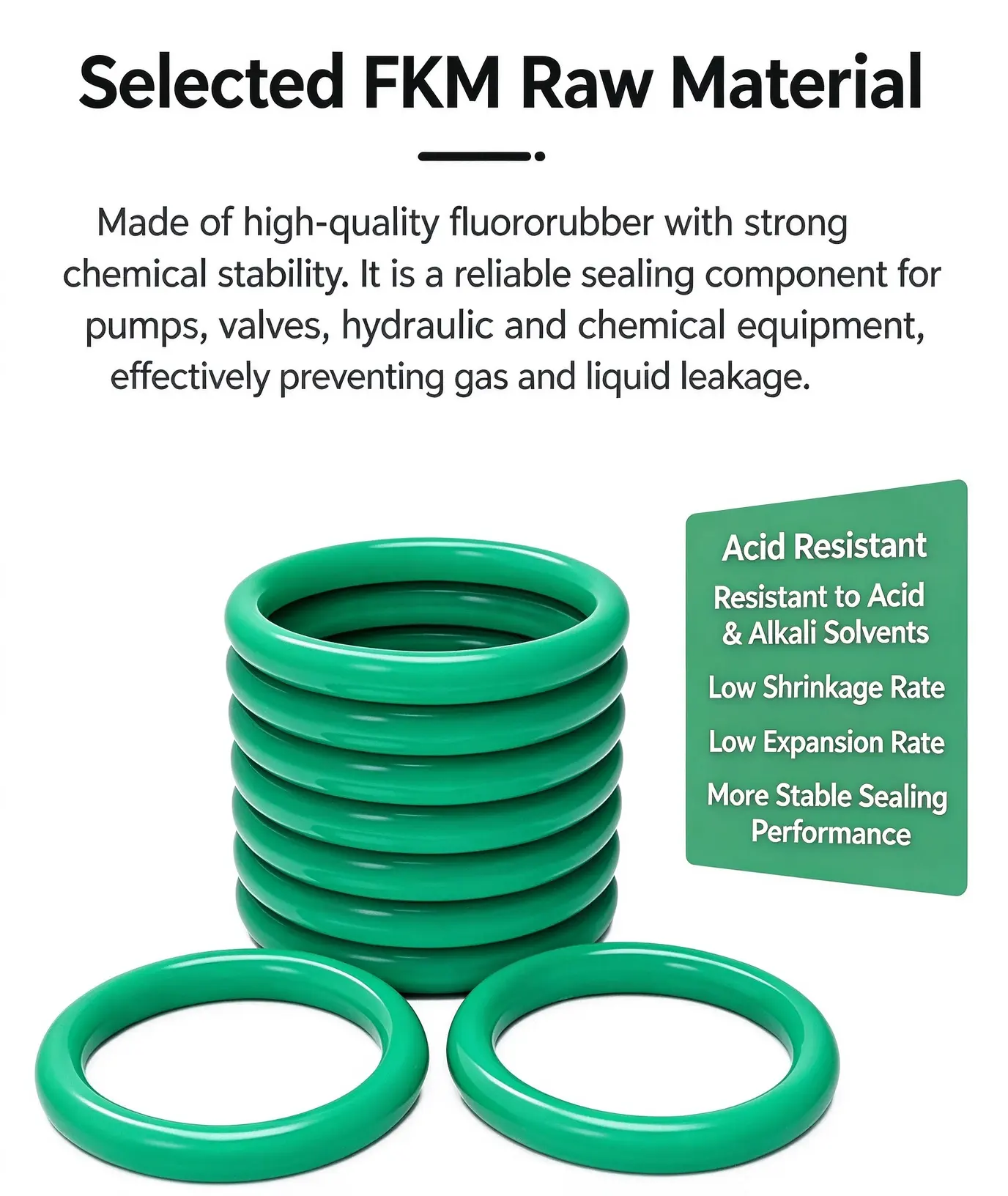
Made from high quality fluoroelastomer, these O rings offer excellent chemical stability and reliable sealing performance for pumps, valves, hydraulic systems, and industrial equipment.
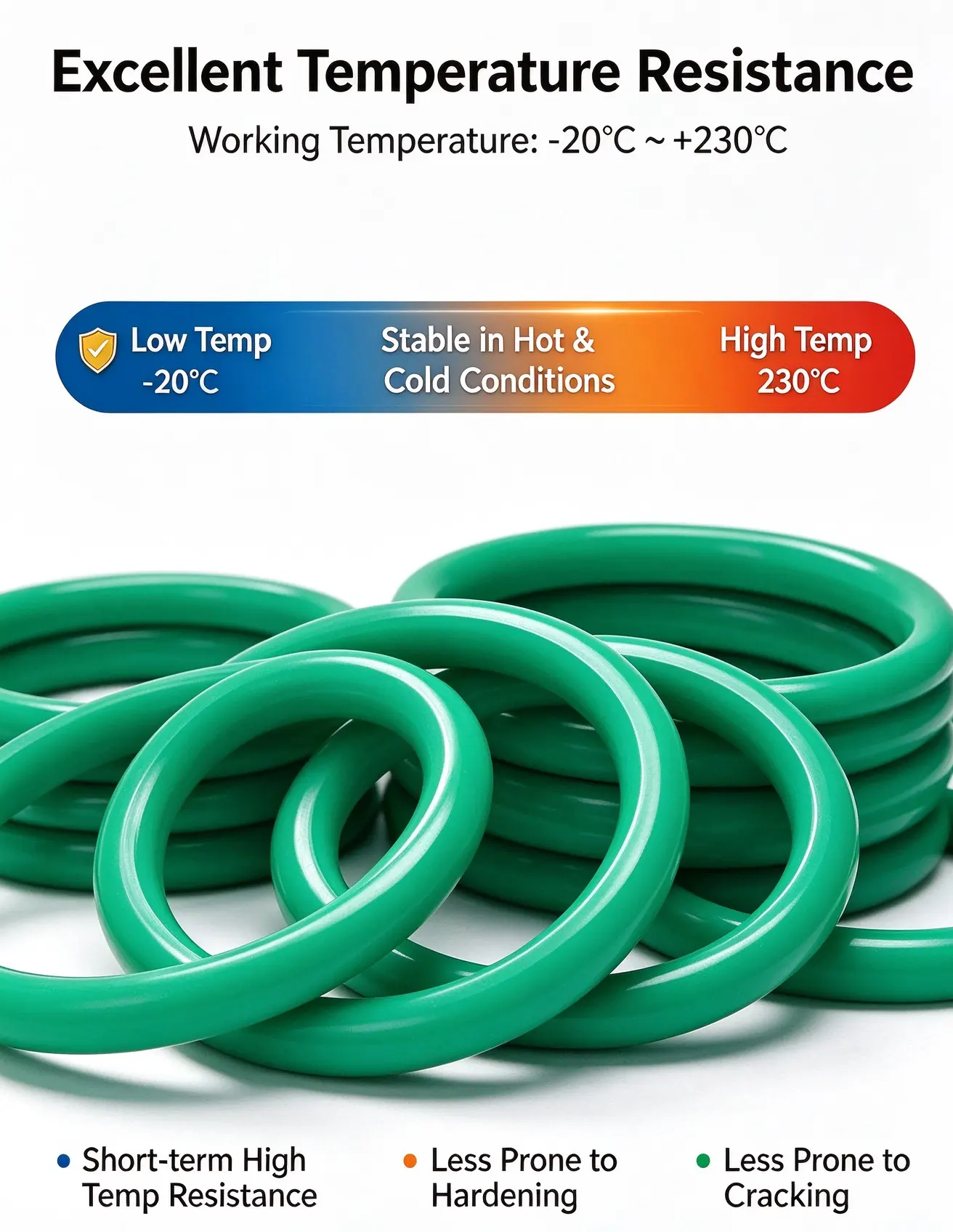
Suitable for demanding thermal environments, with a stated operating temperature range of -20°C to +230°C for compatible compounds. Actual performance depends on the formulation and exposure conditions.
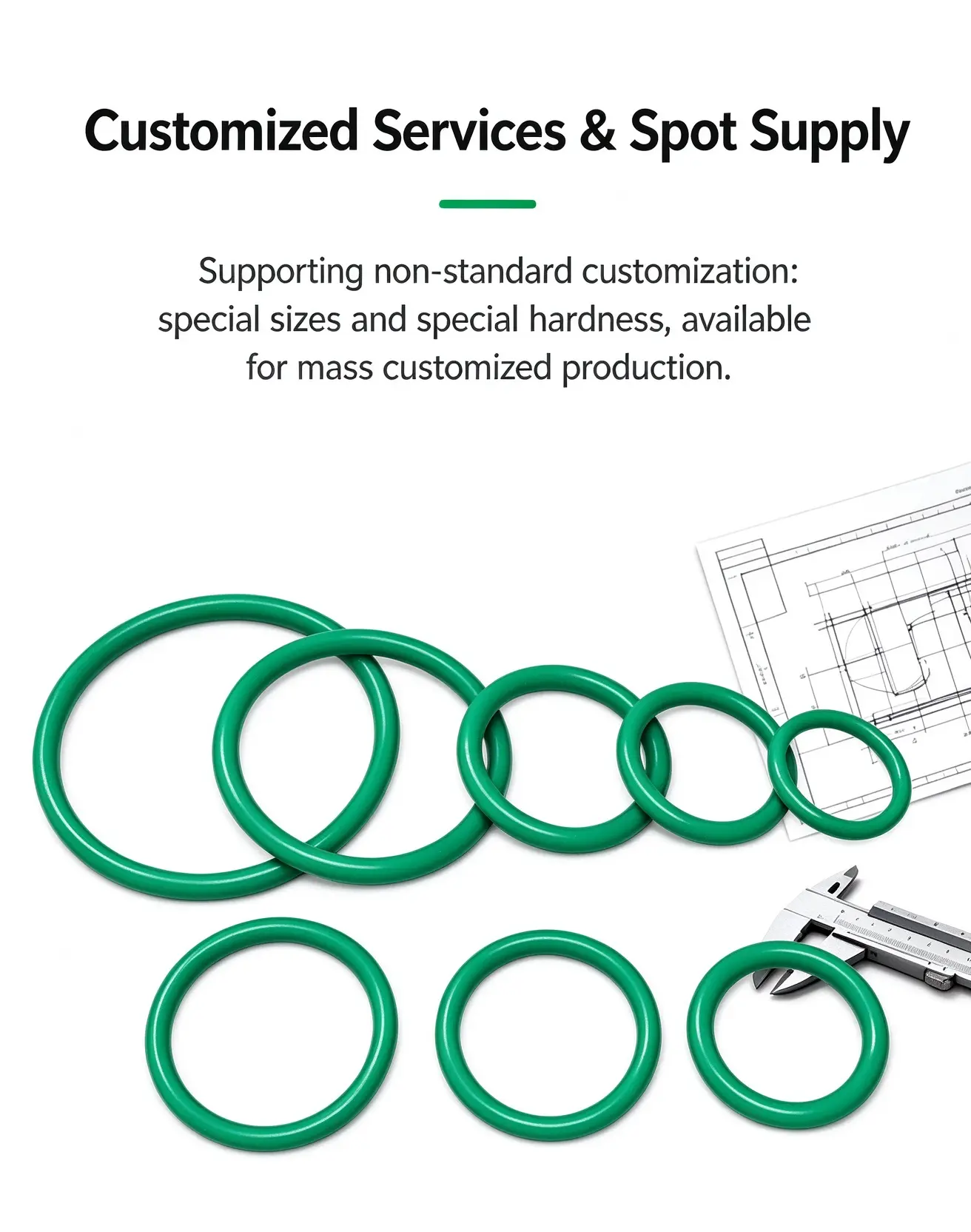
Available in standard sizes and selected stock specifications. Custom manufacturing is available for special dimensions, hardness requirements, and bulk orders.
Application Areas of FKM O-Rings
FKM O rings are widely used in automotive systems, hydraulic and pneumatic equipment, pumps, valves, chemical processing equipment, oil and gas systems, and industrial machinery. With excellent resistance to oils, fuels, heat, and many chemicals, they provide reliable sealing performance in demanding industrial environments, helping prevent fluid and gas leakage and improve equipment reliability.
Multiple Rubber Materials for O Ring Solutions
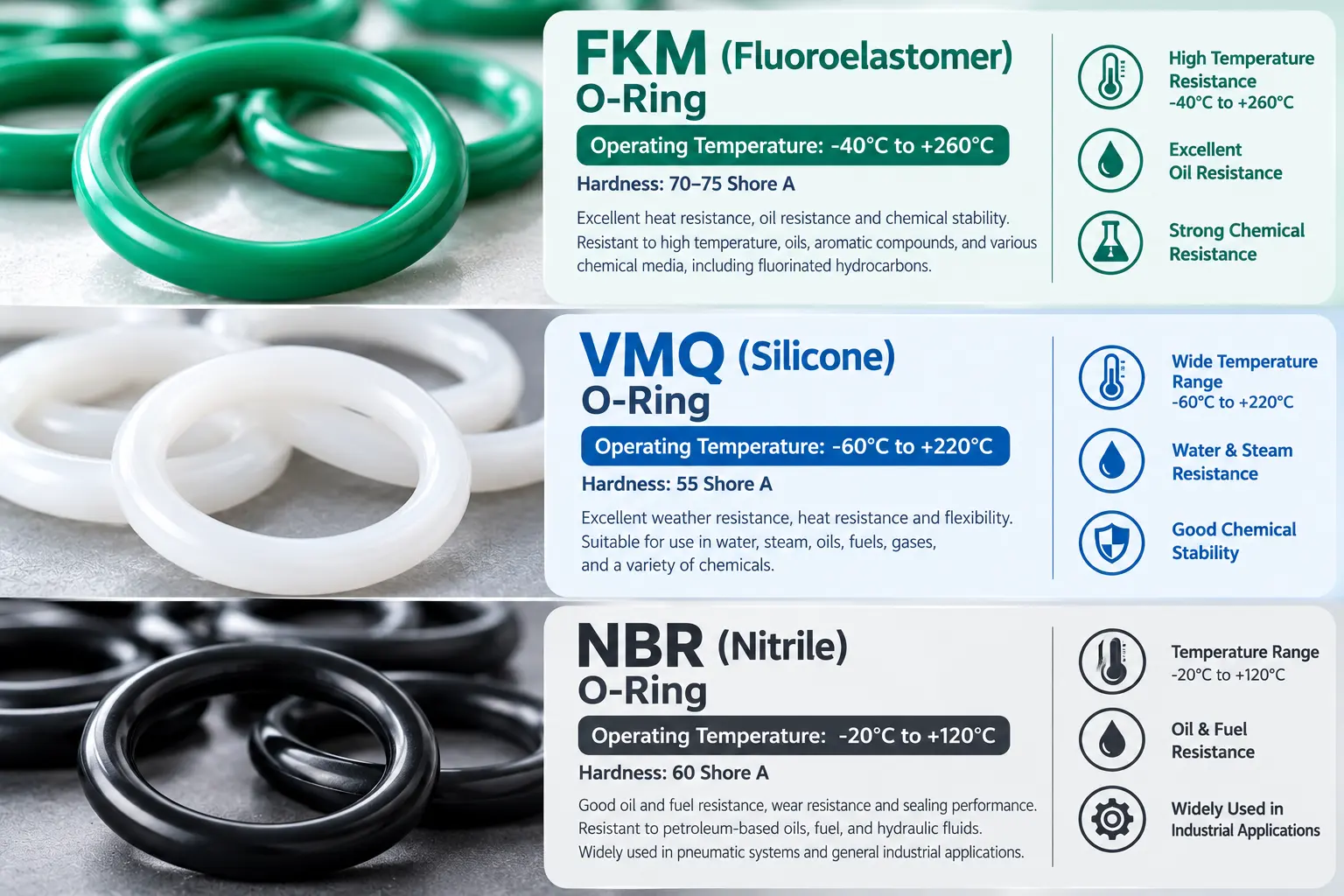
Jinnai Seal specializes in manufacturing O rings in a wide range of rubber materials, including FKM, NBR, EPDM, silicone (VMQ), HNBR, and other elastomers. We offer various sizes, hardness levels, colors, and custom specifications to meet different requirements for temperature resistance, oil resistance, chemical compatibility, and sealing performance. With flexible customization and reliable quality control, we provide tailored sealing solutions for automotive, hydraulic, pneumatic, chemical, and general industrial applications.
Packing /Payment/Shipping service
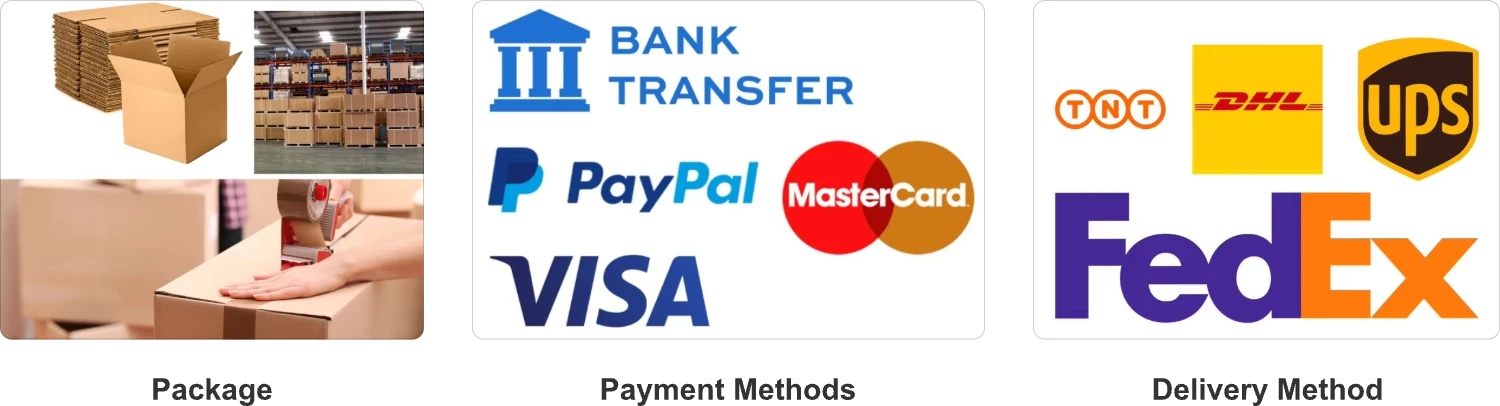
- Package:We provide standard cartons, pallets and wooden cases. Custom packaging is available upon request to protect goods well for different shipments.
- Payment Methods:Multi-currency settlement (CNY, USD, EUR, etc.). Multiple payment options including T/T, PayPal. Local bank transfer is available for some countries for faster transactions.
- Delivery Method:We offer international express, air freight, sea freight and railway transport. You can also appoint your own forwarder for flexible delivery arrangements.
Our Supplied Rubber Seals
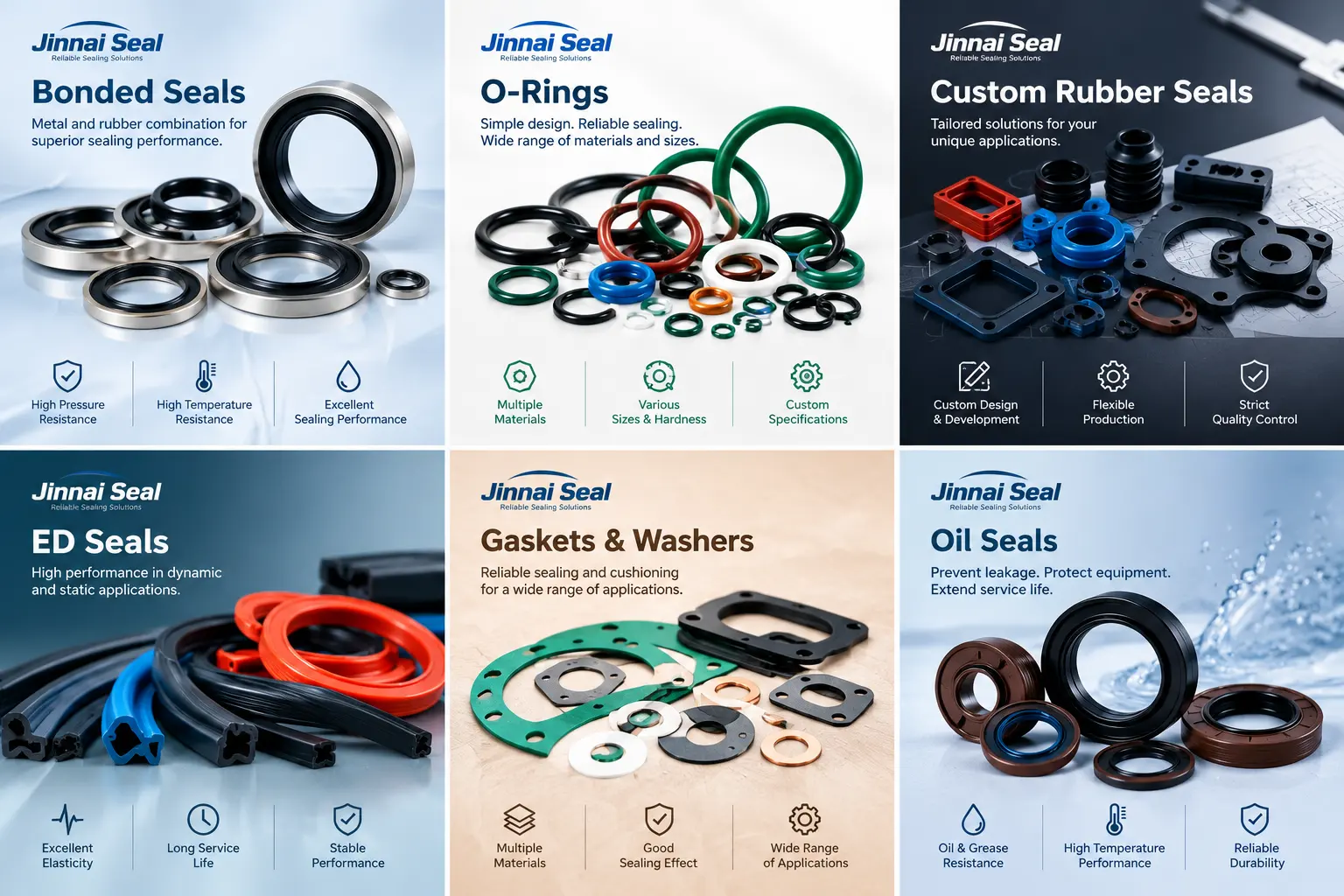
Jinnai Seal specializes in manufacturing a wide range of sealing products, including bonded seals, rubber O rings, custom rubber seals, rubber balls, gaskets and washers, and oil seals. We offer various materials, sizes, colors, and hardness options to meet diverse industrial requirements. With flexible customization and a focus on product quality, we provide reliable sealing solutions for automotive systems, hydraulic and pneumatic equipment, pumps, valves, chemical processing, and general industrial applications. Standard sizes and customized products are available to meet your specific needs.
OEM and ODM Service
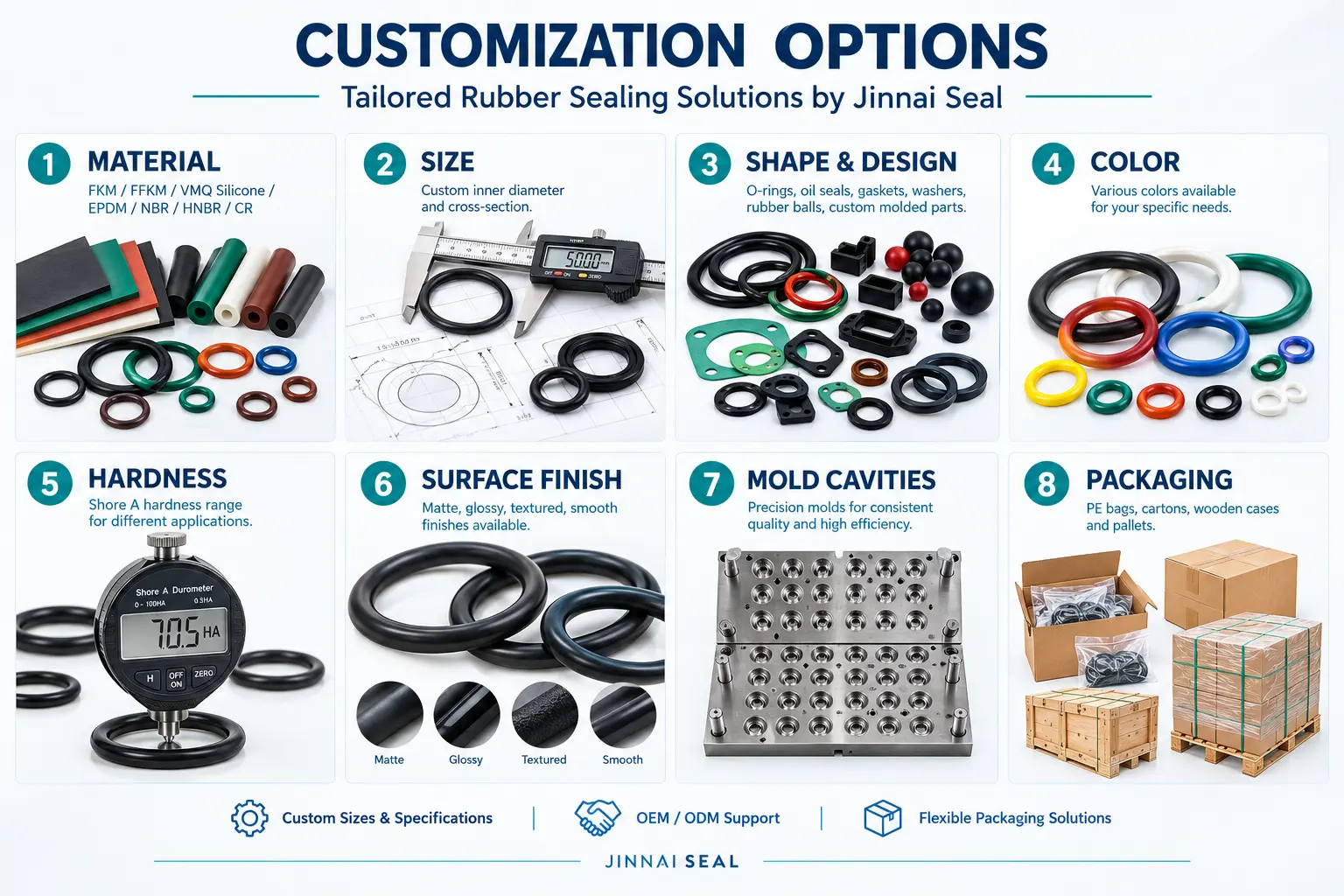
Jinnai Seal provides customized rubber sealing solutions tailored to diverse industrial needs. Our customization services cover rubber materials, dimensions, shapes and designs, colors, hardness, surface finishes, mold development, and packaging. We support both standard specifications and custom manufacturing based on your drawings, samples, and application requirements, delivering flexible and reliable sealing products for a wide range of industries.
OEM order Process
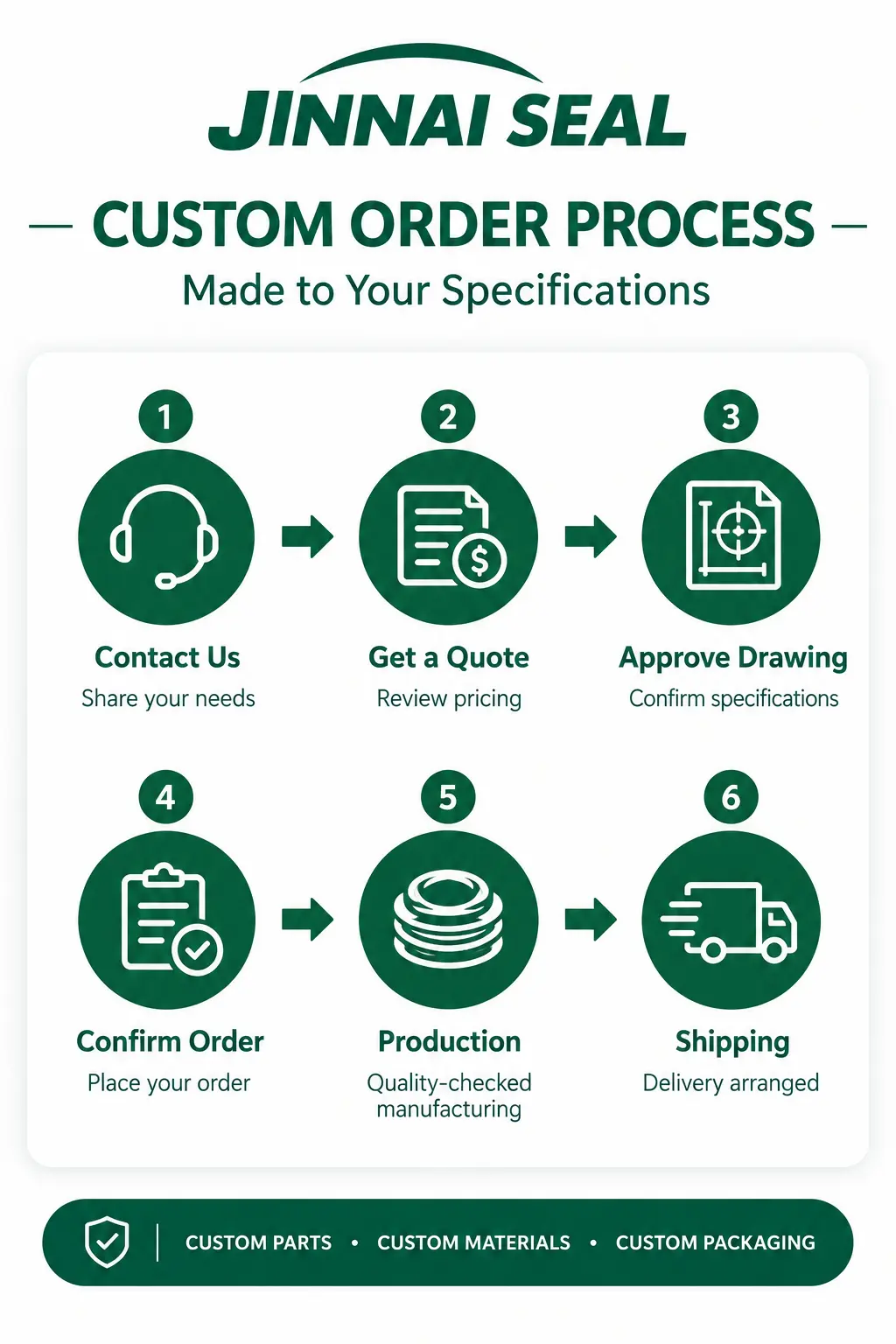
Jinnai Seal offers a simple and efficient custom order process, from initial consultation and quotation to drawing approval, production, quality inspection, and delivery. We provide tailored sealing solutions to meet your specific requirements.
 FAQs
-
How do I select the correct FKM compound for my application?
FKM compounds should be selected based on operating temperature, chemical media, pressure, hardness, and dynamic or static sealing conditions. Different formulations offer different levels of chemical resistance and low-temperature flexibility.
-
What is the difference between standard FKM and low-temperature FKM?
Standard FKM grades generally provide excellent heat and chemical resistance, while low-temperature grades are formulated to maintain flexibility in colder environments. The suitable grade depends on the minimum operating temperature and sealing requirements.
-
How does compression set affect FKM O-ring sealing performance?
Compression set measures the O-ring's inability to recover its original shape after prolonged compression. Excessive compression set can reduce contact pressure and cause leakage, especially under high-temperature, long-term static sealing conditions.
-
Can FKM O-rings be used in dynamic sealing applications?
Yes. FKM O-rings can be used in certain reciprocating and rotary applications. However, friction, sliding speed, lubrication, surface finish, and heat generation must be considered to minimize wear and premature failure.
-
How do I determine the correct O-ring squeeze and gland dimensions?
O-ring squeeze and gland dimensions depend on the cross-sectional diameter, application type, pressure, material hardness, and installation conditions. Proper groove design must also account for gland fill, thermal expansion, and extrusion clearance.
-
What media are NBR O-rings resistant to, and which media are not recommended?
NBR has good resistance to mineral oils, lubricating oils, hydraulic oils, diesel, gasoline and many greases. It is not recommended for ketones (acetone, MEK), esters, aromatic hydrocarbons (benzene, toluene), strong acids, strong alkalis, strongly oxidizing media, or long-term ozone/outdoor exposure. For such media, consider FKM, EPDM, PTFE or other suitable materials.
-
What causes FKM O-rings to swell, crack, or harden prematurely?
Common causes include chemical incompatibility, excessive temperature, rapid decompression, improper material selection, and prolonged exposure to aggressive media. Failure analysis should consider the operating environment and the physical condition of the seal.
-
What are the common O-ring failure modes and how to identify them?
- Compression set: flattened cross-section and flat contact surfaces, from heat or excessive squeeze; - Extrusion (nibbling): ragged, tattered edges on the low-pressure side, from excessive clearance or pressure; - Spiral failure: 45° spiral cuts on the surface, common in long-stroke pistons when parts slide and roll simultaneously; - Abrasion: scratched/worn surfaces from rough mating surfaces or poor lubrication; - Chemical attack: swelling, cracking, or softening from incompatible media.
Related Products
We have developed a diverse portfolio of product solutions to suit different markets and needs.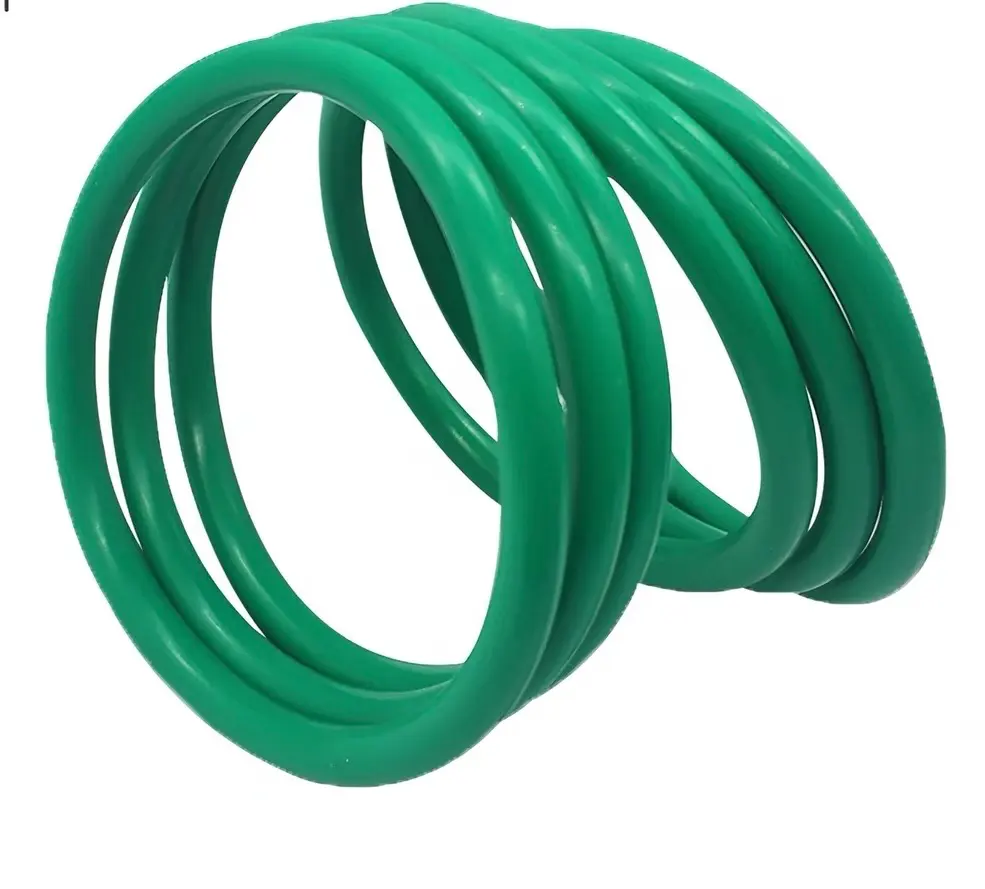

Welcomes